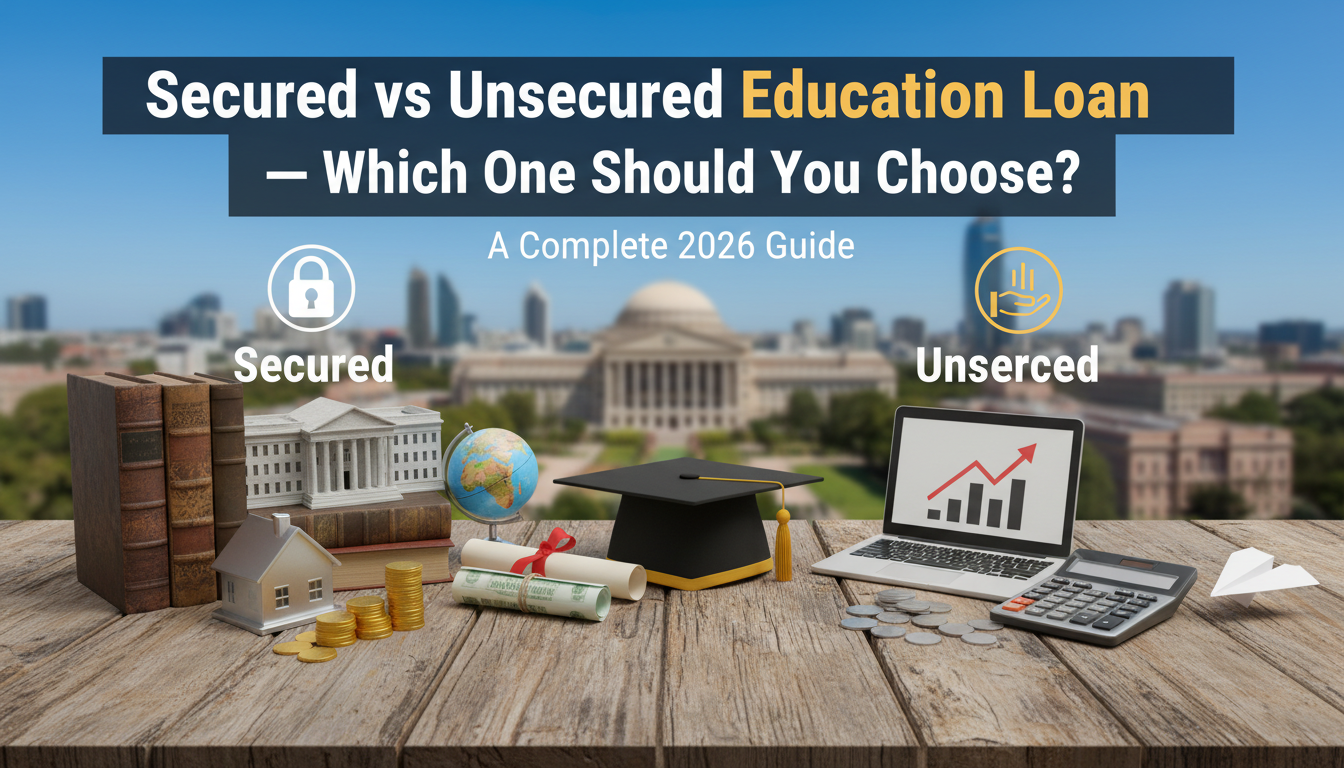
Secured vs Unsecured Education Loan — Which One Should You Choose?
Have you ever found yourself amidst the excitement of receiving an admission letter from your dream university, only to be halted by the daunting task of financing your education? You're not alone. Many students and parents face the critical decision of choosing between a secured and unsecured education loan. The choice isn't always straightforward, and each option has its own set of benefits and challenges.
In this blog, we'll delve deep into the world of education loans, exploring secured and unsecured options to help you make an informed decision. We'll break down the definitions, eligibility criteria, interest rates, and more, providing you with a clear comparison. Whether you're looking to study in India or abroad, this guide aims to demystify the complexities so you can focus on what truly matters—your education.
Secured Education Loans
Secured education loans require you to pledge collateral, such as property, fixed deposits, or other assets, to access the loan. This type of loan is often preferred by banks due to the reduced risk associated with it.
1) Public Sector Banks
Public sector banks in India are known for offering competitive interest rates on secured education loans. For instance, State Bank of India (SBI) offers interest rates starting as low as 7.5% for secured loans. The collateral requirement typically involves a margin of 15% for loans above INR 4 lakh.
Typical advantages:
Limitations:
2) Private Sector Banks
Private banks like HDFC and ICICI provide secured education loans with flexible terms. Interest rates from these institutions start around 8.5%, with similar collateral requirements as public sector banks. However, they may offer a quicker processing time.
Typical advantages:
Limitations:
| Bank Type | Interest Rate (Approx) | Collateral Requirement | Approval Time |
|---|---|---|---|
| Public Sector Bank | 7.5% | 15% margin on loans | Longer due to collateral |
| Private Sector Bank | 8.5% | Similar to public banks | Faster due to streamlined processes |
Unsecured Education Loans
Unsecured education loans do not require any collateral, making them an attractive option for students without substantial assets. However, these loans typically come with higher interest rates.
1) NBFCs (Non-Banking Financial Companies)
NBFCs are significant players in the unsecured loan segment. Companies like Credila and Avanse finance education without requiring collateral. Interest rates usually start at around 11%, with flexible repayment options.
Typical advantages:
Limitations:
2) Government Schemes
The Indian government also supports unsecured loans through schemes like the Central Sector Interest Subsidy Scheme. These schemes primarily target economically weaker sections, providing loans at subsidized rates.
Typical advantages:
Limitations:
Step-by-Step Process to Choose the Right Loan
Step 1: Calculate Your Requirement
Determine the total cost of your education, including tuition, accommodation, and other expenses. This will help you identify the loan amount you need.
Step 2: Evaluate Lender Options
Research different lenders, focusing on interest rates, eligibility criteria, and repayment terms. Consider both banks and NBFCs.
Step 3: Assess Your Eligibility
Check if you meet the eligibility criteria for secured or unsecured loans. This includes evaluating if you have collateral to pledge or meet government scheme requirements.
Step 4: Compare Interest Rates and Fees
Interest rates and associated fees can significantly impact your total repayment. Compare these across lenders to find the most economical option.
Step 5: Consider Loan Tenure and Repayment Flexibility
Look for lenders offering longer tenures and flexible repayment plans that align with your post-graduation financial situation.
Step 6: Gather Required Documentation
Prepare documents like admission letters, identity proofs, and financial statements. For secured loans, ensure your collateral documentation is complete.
Step 7: Apply and Await Approval
Submit your loan application with all required documents. Be patient, as approval times vary by lender and loan type.
People Also Ask
What is the difference between secured and unsecured loans?
Secured loans require collateral, offering lower interest rates and longer repayment periods. Unsecured loans do not require collateral but typically have higher interest rates and shorter repayment terms.
Can I get an unsecured education loan for studying abroad?
Yes, several banks and NBFCs offer unsecured education loans for studying abroad. However, they may have higher interest rates and stringent eligibility criteria compared to domestic loans.
How does the loan repayment process work?
Loan repayment generally begins after a grace period post-course completion. Repayment terms vary, so it's essential to understand the lender's specific schedule and options.
Real-Life Example: Ananya's Decision
Ananya, a student from Mumbai, was accepted into a prestigious MBA program in the USA. She needed INR 30 lakh to cover her expenses. Her family didn't own a property to pledge, making a secured loan challenging.
After consulting with various banks and NBFCs, Ananya opted for an unsecured loan from Credila, which offered her an interest rate of 11.5% with a five-year repayment period. Although the rate was higher, the flexibility and speed of the loan process were crucial. She could start her course without delay, focusing on her studies rather than financial hurdles.
Common Mistakes
Frequently Asked Questions
1) Can I apply for both types of loans simultaneously?
Yes, some students apply for both secured and unsecured loans to cover different aspects of their education costs. However, manageability and repayment capability should be considered.
2) Are there any tax benefits on education loans?
Under Section 80E of the Income Tax Act, you can claim deductions on the interest paid for education loans, making them financially beneficial.
3) What happens if I default on my loan?
Defaulting on a loan can severely impact your credit score and future borrowing capacity. It's crucial to communicate with your lender to explore restructuring options if repayment difficulties arise.
4) How do I calculate the EMI for my education loan?
Most banks and financial institutions provide online EMI calculators. You'll need to input the loan amount, interest rate, and tenure to get an estimate.
5) Can education loans cover living expenses?
Yes, education loans can cover tuition fees, accommodation, and other living expenses. However, the specifics may vary by lender and loan agreement.
Navigating the world of education loans can be overwhelming, but with the right information and guidance, you can make a choice that supports your academic and career goals. At FundMyCampus, founded by IIM Bangalore alumni, we offer personalized assistance to help you compare offers and secure loans starting from 6.75% (subject to T&C). Whether you're pursuing an MBA, MS, or any other course in India or abroad, we're here to help you find the best-fit rate and structure. Visit FundMyCampus to get a free rate comparison and take a confident step towards your educational journey.
About FundMyCampus
FundMyCampus is an IIM Bangalore alum–founded education loan platform that helps students get an education loan at the lowest interest rate by comparing offers from 15+ banks and NBFCs for courses in India and abroad. We provide end-to-end education loan assistance — eligibility check, document support, loan application, sanction, and disbursement — so you avoid delays, confusion, and hidden charges. Our process is transparent and student-first, focused on helping you save money, time, and stress. Whether you need a study abroad education loan or a loan for programs like MBA, MS, MBBS, FundMyCampus helps you choose the best education loan based on your profile and university.

Need Help With Your Education Loan?
Get expert guidance on loans, scholarships & financial planning — free.