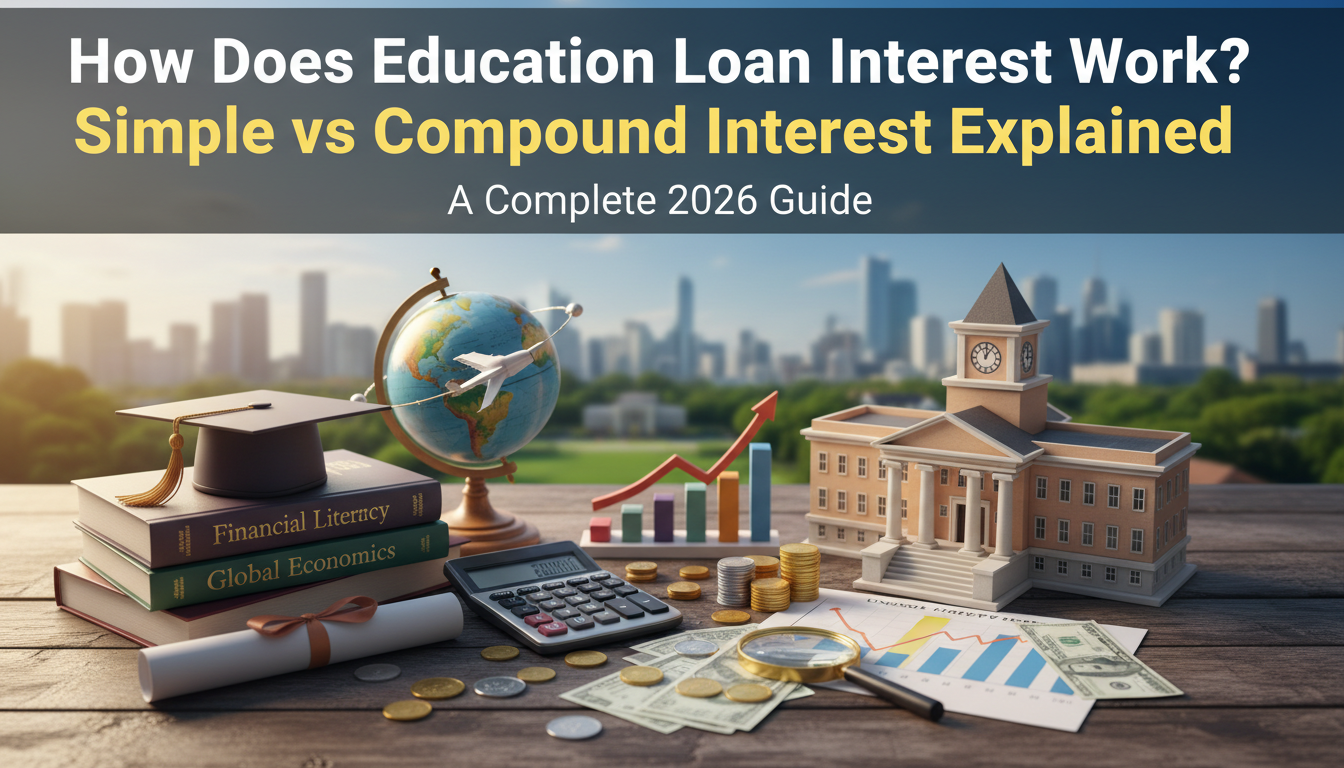
How Does Education Loan Interest Work? Simple vs Compound Interest Explained
Ever found yourself puzzled by how education loan interest really works? You're not alone. Many students and parents dive into the world of loans only to find themselves tangled in terms like "simple" and "compound" interest. This complexity can make it challenging to understand the true cost of borrowing for education.
In this guide, we'll unravel the mysteries behind education loan interest rates. We'll break down the differences between simple and compound interest and explain how each impacts the amount you'll ultimately repay. Whether you're planning to study in India or abroad, knowing how interest works can save you from unexpected surprises.
Once you've read through this blog, you'll have a clear understanding of what education loan interest means, how it's calculated, and what you can do to manage it effectively. Let's dive in.
Understanding Education Loan Interest
Education loan interest is the cost of borrowing money to fund your studies. It's typically expressed as a percentage of the loan amount and can significantly influence the total amount you repay over time.
1) Simple Interest
Simple interest is, as the name suggests, straightforward. It's calculated based on the principal amount of the loan, meaning the original sum borrowed. The interest is not added to the principal, so it doesn't compound over time.
For example, if you borrow INR 5,00,000 at a simple interest rate of 10% per annum for 5 years, the interest would be calculated as:
\[ \text{Interest} = \text{Principal} \times \text{Rate} \times \text{Time} \]
\[ \text{Interest} = 5,00,000 \times 0.10 \times 5 = 2,50,000 \]
You'd pay INR 2,50,000 in interest over the life of the loan.
Typical advantages:
Limitations:
2) Compound Interest
Compound interest, on the other hand, is a bit more complex. Unlike simple interest, it's calculated on the initial principal and also on the accumulated interest from previous periods. This means the interest can "compound" over time, increasing the total amount owed.
Consider a loan of INR 5,00,000 with a compound interest rate of 10% per annum. If compounded annually, the interest for the first year would be:
\[ \text{Interest for Year 1} = 5,00,000 \times 0.10 = 50,000 \]
In the second year, the interest is calculated on INR 5,50,000 (principal + first year's interest):
\[ \text{Interest for Year 2} = 5,50,000 \times 0.10 = 55,000 \]
And so forth, compounding each year.
Typical advantages:
Limitations:
Comparing Simple and Compound Interest
To make it easier to compare, here’s how simple and compound interest stack up over a five-year period for a loan of INR 5,00,000 at a 10% interest rate:
| Year | Simple Interest (INR) | Compound Interest (INR) |
|---|---|---|
| 1 | 50,000 | 50,000 |
| 2 | 50,000 | 55,000 |
| 3 | 50,000 | 60,500 |
| 4 | 50,000 | 66,550 |
| 5 | 50,000 | 73,205.50 |
| Total | 2,50,000 | 3,05,255.50 |
From this table, you can see how compound interest accumulates more over time compared to simple interest.
Factors Influencing Education Loan Interest Rates
Interest rates on education loans aren't one-size-fits-all. They vary based on several factors, including the lender, your credit profile, and the type of course or institution you're attending.
1) Public Sector Banks
Public sector banks in India often provide more favorable interest rates for education loans, especially for courses in recognized institutions. These banks may offer loans with interest rates starting around 6.75% (subject to T&C), though this varies by profile and lender.
Typical advantages:
Limitations:
2) Private Sector Banks
Private banks might offer quicker processing times but tend to have slightly higher interest rates. They are more flexible with their offerings, which can be beneficial for students with varying financial profiles.
Typical advantages:
Limitations:
Step-by-Step Process to Navigate Education Loan Interest
Step 1: Calculate Your Requirement
Start by determining how much you need to borrow. Consider tuition fees, accommodation, and other expenses.
Step 2: Research Different Lenders
Compare interest rates, processing fees, and repayment terms from various banks and financial institutions.
Step 3: Understand the Interest Type
Check whether the interest is simple or compound. This will impact your total repayment amount.
Step 4: Check for Subsidies
Investigate if you qualify for any government subsidies or special schemes that can lower your interest rates.
Step 5: Consider the Repayment Plan
Choose a repayment plan that aligns with your expected income after graduation. Some banks offer grace periods or deferred payments.
Step 6: Factor in Additional Costs
Don't overlook processing fees, late payment penalties, or other charges that may add to the total cost.
Step 7: Apply for the Loan
Once you've gathered all necessary documents and information, proceed with the application through your chosen lender.
People Also Ask
What is a moratorium period in education loans?
A moratorium period is the time during which you don't have to make any loan repayments. Typically, it covers the duration of your course plus an additional period (usually 6-12 months) after graduation. Interest may still accrue during this period, so it's important to understand the terms.
How does loan repayment work for studying abroad?
Education loans for studying abroad often come with higher interest rates. Repayment terms start after the moratorium period, and interest may be compounded annually. It's crucial to plan for currency fluctuations and other expenses when taking a loan for international studies.
Can I change my loan from simple to compound interest?
Once a loan agreement is signed, it's challenging to change the interest calculation method. However, you can refinance the loan with another lender offering more favorable terms, subject to eligibility criteria.
Real-Life Example
Rohan, a student from Mumbai, planned to pursue an MBA in the USA. He needed a loan of INR 30,00,000. After comparing options, he chose a public sector bank offering a compound interest rate of 8% per annum. The bank provided a moratorium period covering his two-year course and six months post-study.
By understanding the compound interest mechanics, Rohan calculated his total repayment. He realized that making partial interest payments during the moratorium could significantly reduce his overall debt. After completing his studies, Rohan secured a well-paying job and managed to pay off his loan within five years.
Common Mistakes
Frequently Asked Questions
1) What is the interest rate for education loans in India?
Interest rates can vary widely, typically ranging from 6.75% to 14% per annum, depending on the lender and the borrower's profile.
2) How is compound interest calculated for loans?
Compound interest is calculated on the initial principal and the accumulated interest from previous periods, leading to interest on interest.
3) Can education loan interest be tax-deductible?
Yes, under Section 80E of the Income Tax Act, you can claim a deduction on the interest paid on education loans, subject to certain conditions.
4) Is it better to pay interest during the moratorium period?
Paying interest during the moratorium period can reduce the total cost of the loan, as it prevents interest from compounding.
5) What happens if I default on my education loan?
Defaulting can severely impact your credit score, and lenders may take legal action. It's crucial to communicate with your lender and explore restructuring options if needed.
Understanding education loans and their interest can seem daunting, but it's essential for making informed decisions about financing your education. With FundMyCampus, founded by IIM Bangalore alumni, you gain access to a platform that helps you compare offers from multiple lenders, ensuring you find the best-fit rate and structure for your needs. Whether you're pursuing an MBA, MS, or MBBS, in India or abroad, our team can guide you through the process with rates starting from 6.75% (subject to T&C). Visit FundMyCampus to get a free rate comparison and take the first step towards financing your future responsibly.
About FundMyCampus
FundMyCampus is an IIM Bangalore alum–founded education loan platform that helps students get an education loan at the lowest interest rate by comparing offers from 15+ banks and NBFCs for courses in India and abroad. We provide end-to-end education loan assistance — eligibility check, document support, loan application, sanction, and disbursement — so you avoid delays, confusion, and hidden charges. Our process is transparent and student-first, focused on helping you save money, time, and stress. Whether you need a study abroad education loan or a loan for programs like MBA, MS, MBBS, FundMyCampus helps you choose the best education loan based on your profile and university.

Need Help With Your Education Loan?
Get expert guidance on loans, scholarships & financial planning — free.