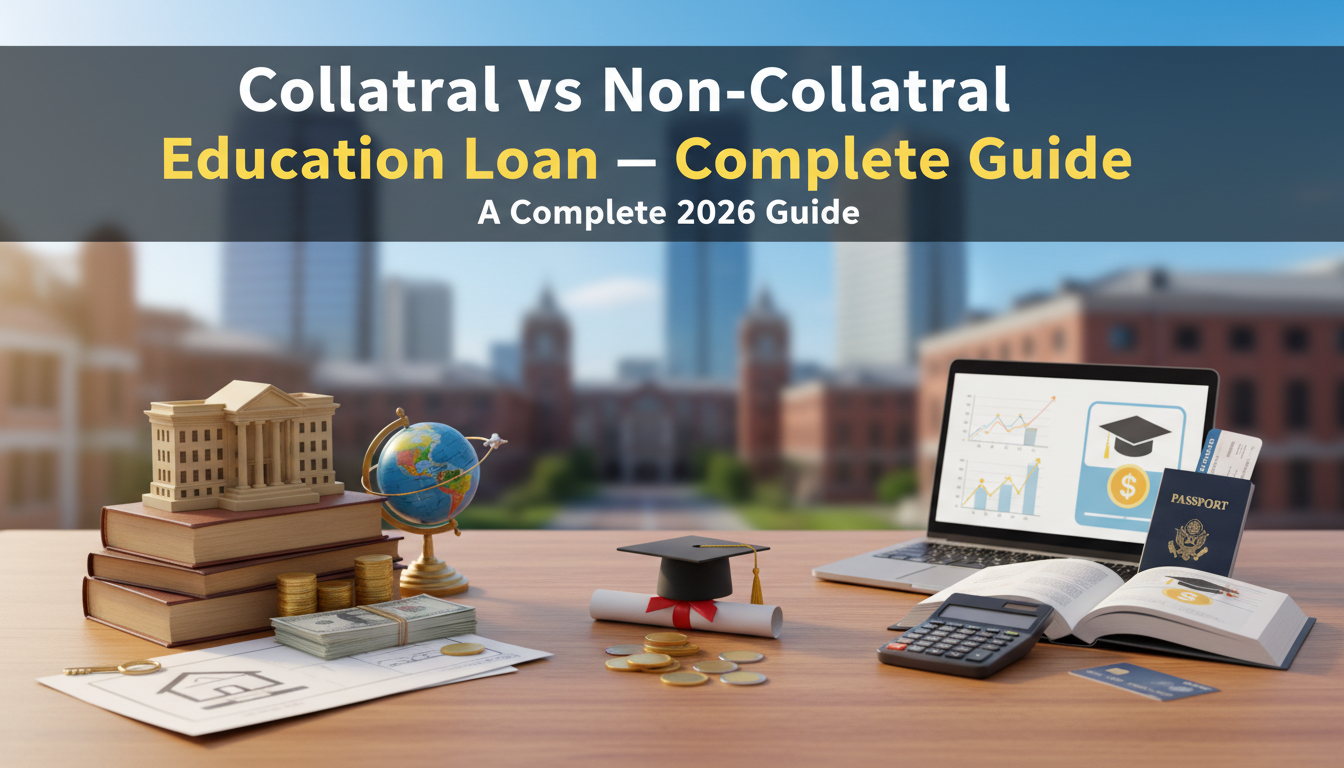
Collateral vs Non-Collateral Education Loan — Complete Guide
Are you planning to pursue higher education but unsure how to fund it? This is a common challenge faced by many students and parents. Education loans can be a crucial step in achieving academic dreams, but the decision between collateral and non-collateral loans can be confusing. This guide will break down the key differences, advantages, and limitations of each type, helping you make an informed choice. We'll delve into eligibility criteria, cost structures, timelines, and more, ensuring you have all the information needed to move forward confidently.
Understanding Collateral and Non-Collateral Education Loans
1) Collateral Education Loans
Collateral education loans require borrowers to pledge an asset as security. This asset could be property, fixed deposits, or other financial instruments. By offering collateral, lenders often provide lower interest rates, making this option appealing to those who can leverage assets.
Typical advantages:
Limitations:
2) Non-Collateral Education Loans
Non-collateral loans don't require any security, making them accessible to students who lack significant assets. While convenient, they may come with higher interest rates and stricter eligibility requirements, such as a strong academic record or co-signer with a solid financial background.
Typical advantages:
Limitations:
Eligibility Criteria and Application Process
1) Public Sector Banks
Public sector banks like SBI and Bank of Baroda offer both collateral and non-collateral loans. Collateral loans usually require assets like property, whereas non-collateral loans depend more on academic performance and co-signer credibility.
Typical advantages:
Limitations:
2) Private Sector Banks
Private banks such as ICICI and Axis Bank provide more flexible loan options. They may offer competitive rates, especially for collateral loans, and have streamlined processes.
Typical advantages:
Limitations:
3) Non-Banking Financial Companies (NBFCs)
NBFCs such as HDFC Credila specialize in education loans, offering tailored solutions for diverse needs. They might be more lenient with eligibility criteria for non-collateral loans.
Typical advantages:
Limitations:
Costs, Rates, and Fees
Understanding the financial implications is crucial. Interest rates vary significantly, often ranging from 6.75% to 10% based on loan type and lender. Processing fees, typically 1-2% of the loan amount, can add to your expenses. Prepayment penalties may also apply, affecting your total cost.
| Loan Type | Interest Rate Range | Processing Fee | Loan Limit |
|---|---|---|---|
| Collateral Loan | 6.75% - 9% | 1% - 2% | INR 1.5 crore |
| Non-Collateral | 8.5% - 10% | 1% - 2% | INR 40 lakh |
Step-by-Step Process
Step 1: Calculate Your Requirement
Assess your tuition fees, living expenses, and miscellaneous costs. Ensure you borrow only what you need to avoid unnecessary debt.
Step 2: Research Lenders
Explore different lenders, comparing interest rates, terms, and benefits. Consider both banks and NBFCs.
Step 3: Assess Eligibility
Check your eligibility for collateral and non-collateral loans. If you lack assets, focus on enhancing your academic profile.
Step 4: Prepare Documentation
Gather necessary documents, including academic records, income proof, and asset details for collateral loans.
Step 5: Apply for Loan
Submit your application, ensuring all information is accurate. Follow up with lenders regularly to track progress.
Step 6: Negotiate Terms
If approved, discuss terms with your lender. Negotiate interest rates and repayment schedules for better affordability.
Step 7: Finalize Agreement
Carefully review the loan agreement before signing. Ensure all terms align with your financial strategy.
People Also Ask
What is the maximum loan amount for education loans?
The maximum loan amount varies by lender and loan type. Collateral loans can go up to INR 1.5 crore, while non-collateral loans are typically capped at INR 40 lakh.
Can I switch from a non-collateral to a collateral loan?
Yes, you may switch if you acquire eligible assets. Contact your lender to discuss transitioning and potential benefits.
How long does it take to process an education loan?
Processing time varies. Collateral loans may take longer due to asset valuation, often extending to several weeks. Non-collateral loans can be processed in a few days if documentation is complete.
Real-Life Example
Meet Priya, a student aiming to study MBA in the USA. Priya needed INR 60 lakh for her education but had no assets to pledge. She opted for a non-collateral loan from an NBFC at 9% interest. Although the rates were higher, the quick approval helped her secure admission. Priya diligently compared lenders and negotiated terms, ensuring manageable monthly repayments. Her proactive approach underscored the importance of thorough research and understanding loan dynamics.
Common Mistakes
Frequently Asked Questions
1) Can I apply for an education loan without a co-signer?
Yes, non-collateral loans might allow this, but eligibility can depend on your academic performance and future earning potential.
2) Are there tax benefits on education loans in India?
Yes, under Section 80E of the Income Tax Act, you can claim tax deductions on interest paid on education loans.
3) What happens if I default on an education loan?
Defaulting can impact your credit score significantly. Lenders may seek legal action or recovery through asset seizure.
4) How does FundMyCampus assist with education loans?
FundMyCampus helps compare offers across multiple lenders, aiding in finding the best rates and structures. We support loans for both domestic and international education.
5) Is prepayment allowed for education loans?
Yes, most lenders allow prepayment, but some may charge penalties. Always confirm terms before proceeding.
Navigating the education loan landscape can be daunting, but understanding your options is the first step toward success. Whether you choose collateral or non-collateral loans, ensuring the right fit for your financial situation is key. FundMyCampus, founded by IIM Bangalore alumni, offers education loans starting from 6.75% (subject to T&C) and supports courses like MBA, MS, and MBBS, both in India and abroad. Visit FundMyCampus to get a free rate comparison and make your educational dreams a reality.
About FundMyCampus
FundMyCampus is an IIM Bangalore alum–founded education loan platform that helps students get an education loan at the lowest interest rate by comparing offers from 15+ banks and NBFCs for courses in India and abroad. We provide end-to-end education loan assistance — eligibility check, document support, loan application, sanction, and disbursement — so you avoid delays, confusion, and hidden charges. Our process is transparent and student-first, focused on helping you save money, time, and stress. Whether you need a study abroad education loan or a loan for programs like MBA, MS, MBBS, FundMyCampus helps you choose the best education loan based on your profile and university.

Need Help With Your Education Loan?
Get expert guidance on loans, scholarships & financial planning — free.