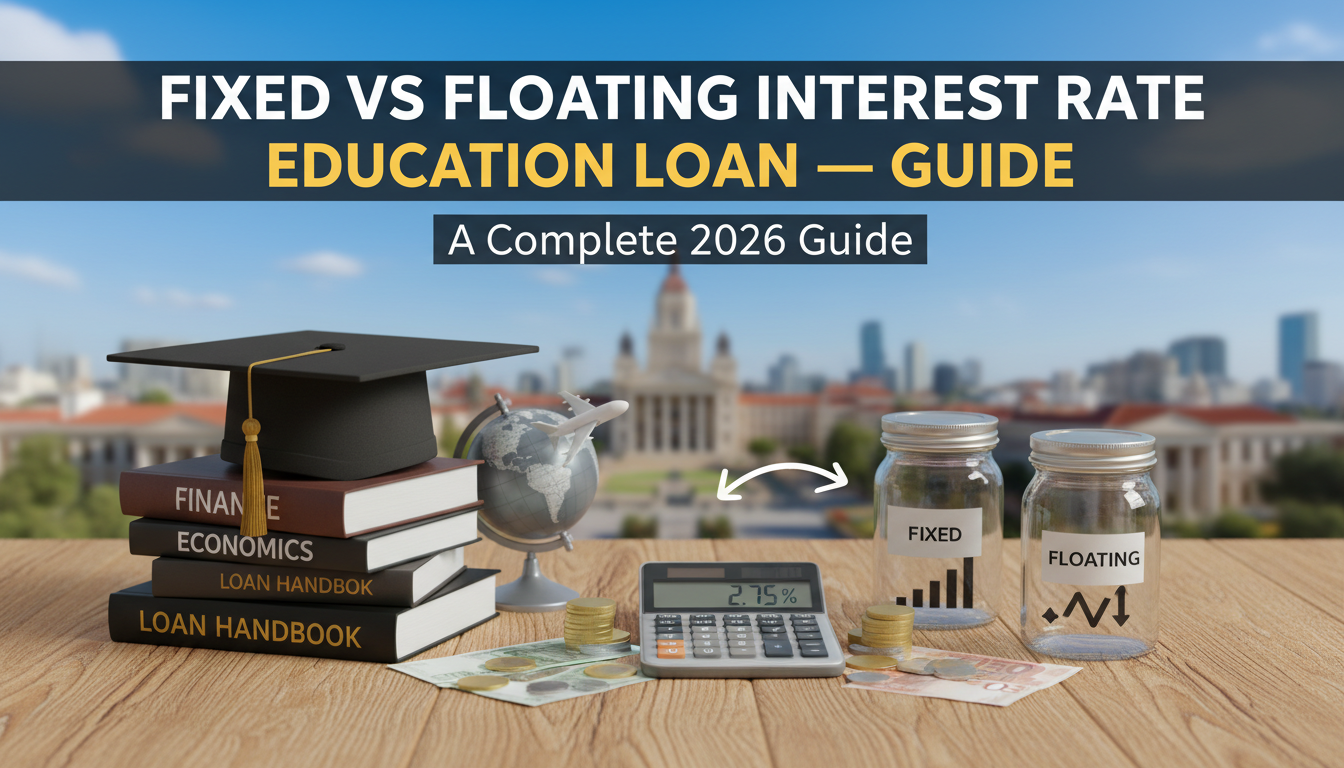
Fixed vs Floating Interest Rate Education Loan — Guide
Education loans can be a stepping stone to your dream career, but choosing between fixed and floating interest rates can feel daunting. Imagine being Ananya, an aspiring MBA student who’s just received her acceptance letter to a prestigious university abroad. She's thrilled but also anxious about the financial commitment. Should she opt for a fixed interest rate loan or go for a floating rate? It's a common dilemma that many students face. You're not alone in this confusion, and this guide is here to clarify the differences, advantages, and potential drawbacks of each type of interest rate.
We'll delve into what fixed and floating interest rates entail, their eligibility criteria, costs, and timelines. You'll also find practical guidance to help you make an informed decision tailored to your needs. Let's navigate this journey together and find the best-fit option for your educational aspirations.
Fixed vs Floating Interest Rates: Definitions and Considerations
Understanding the difference between fixed and floating interest rates is crucial when choosing an education loan. Here, we break down each type and discuss their implications.
1) Fixed Interest Rate
A fixed interest rate remains constant throughout the loan term. This means your monthly payment won’t change over time, providing a sense of stability and predictability. Fixed rates are typically higher than floating rates because they offer more security to the borrower.
Typical advantages:
Limitations:
2) Floating Interest Rate
Floating interest rates vary according to market conditions, typically linked to a benchmark rate like the RBI's repo rate. These rates tend to be lower initially but can fluctuate over time.
Typical advantages:
Limitations:
Eligibility, Costs, and Timelines
Choosing the right interest rate isn't just about current market conditions; it's also about understanding the eligibility, costs, and timelines associated with each option.
1) Public Sector Banks
Public sector banks in India often offer education loans with both fixed and floating interest rates. Fixed rates may range from 9% to 12%, while floating rates are generally 8% to 11% depending on the repo rate.
Typical advantages:
Limitations:
2) Private Banks
Private banks might offer slightly more competitive rates due to their flexibility. Fixed rates could range from 10% to 13%, while floating rates might be between 9% and 12%. Each bank may have unique eligibility criteria, influenced by factors like university reputation and student's credit score.
Typical advantages:
Limitations:
3) Non-Banking Financial Companies (NBFCs)
NBFCs offer another avenue for education loans. They often have floating rates that start lower than banks but can increase over time. Fixed rates might range from 11% to 15%.
Typical advantages:
Limitations:
| Type of Institution | Fixed Rate Range | Floating Rate Range |
|---|---|---|
| Public Sector Banks | 9% - 12% | 8% - 11% |
| Private Banks | 10% - 13% | 9% - 12% |
| NBFCs | 11% - 15% | Variable |
Step-by-Step Process to Choose the Right Rate
Making an informed decision requires a systematic approach. Here’s a step-by-step guide to help you choose between fixed and floating interest rates.
Step 1: Assess Your Financial Stability
Evaluate your current financial status and future earning potential. Fixed rates offer stability, which may be suitable if you prefer predictable expenses.
Step 2: Research Market Trends
Stay updated on market trends and predictions. If experts anticipate a decrease in interest rates, a floating rate might be beneficial.
Step 3: Compare Lenders
Research different lenders to compare rates, terms, and fees. Consider banks, NBFCs, and other financial institutions.
Step 4: Calculate Total Loan Costs
Factor in processing fees, prepayment penalties, and total interest payable over the loan term. This will help you see the true cost of each option.
Step 5: Evaluate Course and Location
If your course or country of study is reputed, lenders might offer better rates. Compare offers based on these factors.
Step 6: Check Loan Repayment Terms
Understand the repayment terms and conditions. Some lenders offer flexible repayment plans which could benefit you if your income fluctuates.
Step 7: Seek Expert Advice
Consult financial advisors or use platforms like FundMyCampus to get a comprehensive comparison and personalized advice.
People Also Ask
How do market conditions affect floating interest rates?
Floating interest rates are directly influenced by market conditions, particularly the RBI's repo rate. When the repo rate is lowered, floating rates tend to decrease, benefiting borrowers. Conversely, if the repo rate increases, your loan repayments may rise.
Is it possible to switch from a fixed to a floating rate during the loan term?
Yes, some lenders allow you to switch from a fixed to a floating rate. However, this may involve additional fees or altered terms. It's crucial to read the loan agreement carefully and consult with your lender before making a switch.
How do education loan interest rates abroad differ from India's?
Interest rates for education loans abroad vary by country and lender. In the US, for example, rates can be both fixed and variable, often influenced by federal loan policies and the creditworthiness of the borrower. Comparing these thoroughly before deciding is essential.
Real-Life Example: Ananya's Decision
Ananya, accepted into an MBA program in the UK, was faced with choosing between a fixed and floating interest rate. After comparing different lenders, she found that a public sector bank offered her a fixed rate at 10.5% and a floating rate starting at 9.5%. Given the current market predictions of stable interest rates and her preference for predictable payments, Ananya opted for a fixed rate loan. She felt this would ease her financial planning during her studies.
Common Mistakes
Frequently Asked Questions
1) What is the interest rate for education loans in India?
Education loan rates in India vary widely. Fixed rates can range from 9% to 15%, while floating rates may start lower but change over time based on market conditions.
2) Can interest rates change for fixed-rate loans?
No, fixed-rate loans maintain the same interest rate throughout the loan term. This provides stability, regardless of market fluctuations.
3) Is a floating rate loan better for short-term courses?
Floating rate loans may be advantageous for short-term courses if market rates are predicted to decrease. However, this involves risk, as rates can rise unexpectedly.
4) Are there tax benefits on education loan interest in India?
Yes, under Section 80E of the Income Tax Act, interest paid on an education loan is eligible for tax deduction. This benefit is available for up to 8 years from the start of repayment.
5) Can I prepay my education loan?
Yes, most lenders allow prepayment. However, some may charge a fee for early settlement. It's important to review the terms before making any decision.
Education loans are a significant commitment, and understanding interest rate dynamics is vital. With FundMyCampus, you have the advantage of comparing offers from various lenders, ensuring you find the best-fit rate and structure for your education journey. Founded by IIM Bangalore alumni, FundMyCampus supports loans starting from 6.75% (subject to T&C), catering to courses in India and abroad, including MBA, MS, MBBS, and more. Visit FundMyCampus to get a free rate comparison and make a well-informed decision for your future.
About FundMyCampus
FundMyCampus is an IIM Bangalore alum–founded education loan platform that helps students get an education loan at the lowest interest rate by comparing offers from 15+ banks and NBFCs for courses in India and abroad. We provide end-to-end education loan assistance — eligibility check, document support, loan application, sanction, and disbursement — so you avoid delays, confusion, and hidden charges. Our process is transparent and student-first, focused on helping you save money, time, and stress. Whether you need a study abroad education loan or a loan for programs like MBA, MS, MBBS, FundMyCampus helps you choose the best education loan based on your profile and university.

Need Help With Your Education Loan?
Get expert guidance on loans, scholarships & financial planning — free.