Full guide: Education Loan Without Collateral lenders, rates, eligibility and documents in one place.
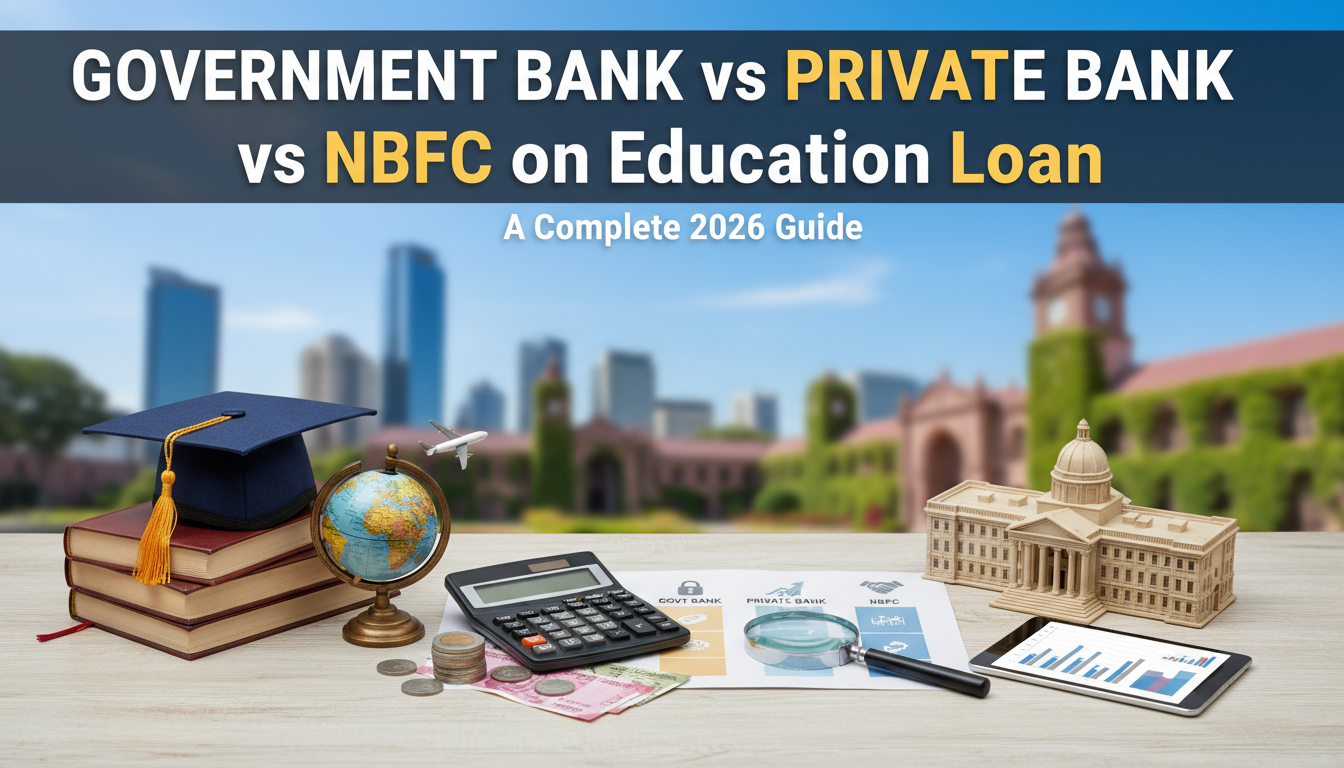
Government Bank vs Private Bank vs NBFC on Education Loan
Three kinds of lender compete for the same student: the government-owned bank that most parents already know, the private bank with its quicker service, and the non-banking financial company whose NBFC education loan promises to say yes where banks hesitate. Each pitch contains some truth. None of them is true for every student, and the cheapest lender on paper can turn out to be the costliest once fees, security and delays are counted.
Here the three are set side by side using rates, limits and fees that lenders publish themselves, as read on 31 October this year. The aim is to show how each type behaves, so a family can decide where to apply first, not to crown a winner.
What separates a government bank, a private bank and an NBFC?
A government bank, also called a public sector bank, is one in which the government holds the majority stake. State Bank of India (SBI) is the best-known example. A private bank is owned by shareholders, as with HDFC Bank, ICICI Bank and Axis Bank. A non-banking financial company, or NBFC, is a lender registered with the Reserve Bank of India (RBI) that lends money but does not take deposits or run current accounts in the way a bank does. An NBFC education loan is simply an education loan from such a lender.
The practical differences come down to four things: price, how much they lend without property as security, how fast they move, and how strictly they stick to a fixed scheme. Public banks follow the schemes in their rate cards. Private banks vary more by profile. An NBFC education loan is usually priced on the borrower's course and co-applicant, so quotes differ more from person to person.
What do government banks offer?
Many public banks follow the model scheme drawn up by the Indian Banks' Association. As Canara Bank's summary of that scheme shows, there is no margin, meaning no share of the cost for the family to pay, up to ₹4 lakh. Above that the margin is 5% for study in India and 15% for study abroad. Merit-quota loans up to ₹7.5 lakh carry no collateral and are covered by a credit guarantee fund, while larger loans need tangible collateral equal to the loan. Repayment runs for up to 15 years, not counting the course period plus one year of moratorium.
Moratorium is the repayment holiday that covers the course and some time after it. During it, interest keeps building up on the loan, though no instalment is due.
Government banks are generally the cheapest on published rates, and an NBFC education loan may not beat them on price. They can also take longer to decide, because a branch must verify documents and collateral, though timelines differ by branch.
SBI's education loan rate card, effective 15 October 2026, lists 9.65% for a Student Loan with collateral and 10.15% without, up to ₹7.5 lakh. The Scholar Loan for select institutions is 7.15% to 7.90%, and students of premier institutions get a 7.00% concession valid until 31 December this year. SBI charges no processing fee on Student Loans up to ₹10 lakh.
What a government bank gives in price, it often takes back in process. Property valuation, legal checks and the co-borrower's documents can add weeks.
What do private banks offer?
Private banks sit between public banks and NBFC lenders on price and speed. Several advertise large limits and options without collateral at select institutes. Their rates are usually higher than a public bank's and are shown as "starting from" figures, since the final rate depends on the course, the institution and the co-applicant's income and credit record.
HDFC Bank's education loan page advertises Indian education loans from 10.50% a year, with no processing fee up to ₹7.5 lakh and 1% on larger loans. It offers loans of up to ₹1.5 crore, of which up to ₹50 lakh needs no collateral at select institutes, and a repayment period of up to 15 years.
A private bank can suit a student with a strong offer from a well-known university but no property to pledge, because the bank can lean on the institution's standing.
Rate resets matter as well. A floating rate that resets every few months follows the repo rate faster than one that resets once a year, and the sanction letter should say which applies.
ICICI Bank's education loan page lists rates from 9.00% for secured loans abroad and 10.25% for unsecured ones, with limits of up to ₹3 crore, tenures of up to 15 years and no foreclosure charges. It also offers three repayment options: partial simple interest, simple interest and EMI (equated monthly instalment).
Private banks generally want a co-applicant too, and the co-applicant's credit record matters as much as the student's admission.
What does an NBFC education loan offer?
Lenders in this group pitch themselves on speed and on fitting students that banks find hard to place in a scheme. Many offer an NBFC education loan mainly for study abroad, and some lend mainly on the strength of the admission offer and the co-applicant's income.
Credila, one of the best-known names, publishes its terms on an interest rates and charges page. It lists secured floating loans from 9.95% and unsecured loans from 11.25%, no stated upper limit, an origination fee of up to 1.25% plus goods and services tax (GST), and no prepayment penalty. A co-applicant is mandatory.
Those starting rates show how an NBFC education loan can be priced close to a bank when security is offered, and well above one when it is not.
Speed is the main selling point of this group, and it is worth testing. Sanction times in marketing copy assume complete papers, so ask for the actual timeline in writing.
Avanse, another NBFC, advertises loans of up to ₹2 crore without collateral and says it can process paperwork in as little as three days. Its education loan page quotes interest rates from 10%, though the figure that applies to you depends on your course and profile.
NBFC education loan vs bank loan: how do rates and fees compare?
Published starting rates for a bank loan and an NBFC education loan sit in a fairly tight band, but starting rates are not what most borrowers pay. The table shows what ₹20 lakh would cost over 15 years at several published starting rates. It is an illustration using standard EMI arithmetic, which ignores interest during the moratorium, and the rates are not offers.
| Published starting rate | Lender type | Monthly instalment | Total interest |
|---|---|---|---|
| 9.65% | Government bank (SBI Student Loan with collateral) | ₹21,066 | ₹17.92 lakh |
| 9.95% | NBFC (Credila secured) | ₹21,431 | ₹18.58 lakh |
| 10.50% | Private bank (HDFC Bank, India) | ₹22,108 | ₹19.79 lakh |
| 11.25% | NBFC (Credila unsecured) | ₹23,047 | ₹21.48 lakh |
The spread between the cheapest and the dearest row is about ₹1,981 a month, or ₹3.56 lakh over the loan. That gap is the price of speed or of not pledging property when choosing an NBFC education loan.
Fees add to it. On ₹20 lakh, Credila's maximum origination fee of 1.25% would be ₹25,000 plus GST. SBI's fee on a loan between ₹10 lakh and ₹20 lakh is ₹5,000 plus GST, and HDFC Bank's 1% above ₹7.5 lakh would be about ₹20,000. These are simple calculations on published percentages, so check your own sanction letter.
Is an NBFC education loan safe and regulated?
An NBFC education loan comes from a lender that the RBI registers and supervises, so some of the same RBI rules apply to it as to banks. The RBI's pre-payment charges directions cover commercial banks, co-operative banks, NBFCs and all-India financial institutions. For loans sanctioned or renewed on or after 1 January this year, they bar prepayment charges on floating-rate loans that individuals take for non-business purposes.
That means the right to prepay is not a point of difference between lender types for a floating-rate education loan. Fixed-rate loans fall outside the rule, so read the loan type in the sanction letter.
Some lenders also charge fees at the start, such as an application or documentation fee, so compare the cash needed in the first year as well as the rate.
Penal charges for late payment are also regulated. The RBI's circular on penal charges applies to banks and NBFCs alike, and requires penal charges to be reasonable and not capitalised.
Regulation does not mean every lender is equally good. Read the sanction letter for the rate type, the reset schedule, every fee and the penal charge before accepting it.
Which lender type suits which student?
A student at a premier or highly ranked Indian institution, or one who qualifies for the PM-Vidyalaxmi scheme, should check public banks before turning to an NBFC education loan. The scheme caps the rate at the bank's benchmark plus 0.5% for students at 1,425 designated Indian institutions, and adds a 3% interest subvention for family income up to ₹8 lakh.
A family that can pledge property and is not in a rush will often find the lowest cost at a public bank.
A student with a strong admission abroad and no collateral can compare private banks and NBFCs on the same loan. Pay attention to the processing fee, the rate type and the penal charge, not just the starting rate.
A student with a tight deadline, a less common course or a thin application may find an NBFC education loan the only route that moves in time. In that case, ask what interest is charged during the course and how soon instalments begin.
How do you compare offers fairly?
Ask every lender, bank or NBFC education loan provider alike, for the same set of facts in writing.
- The rate, whether it is floating or fixed, and how often it resets
- The processing or origination fee, with GST
- Whether collateral is needed and at what loan size
- The moratorium and how interest is treated during it
- The penal charge for late payment
- The time between a complete application and disbursal
Line the offers up with the same loan amount and tenure, and choose on total cost and certainty.
Common questions
Is an NBFC education loan always costlier than a bank loan?
Not always. Where security is offered, the secured rate on an NBFC education loan can be close to a bank's. Unsecured NBFC loans usually cost more.
Can an NBFC education loan be moved to a bank later?
Banks and NBFCs both offer refinancing or balance transfer products in some cases, so an NBFC education loan can often be moved after some repayment if the new lender agrees.
Does the tax benefit differ by lender type?
The interest deduction under Section 129 of the Income-tax Act, 2025, the successor to Section 80E, is for loans from approved financial institutions or charitable trusts. Check that your lender qualifies and that your tax regime allows the deduction.
FundMyCampus is an education loan advisory platform founded by an alumnus of the Indian Institute of Management Bangalore. It is not a bank, and it says it does not charge students any fee. With 12 or more banking partners and free tools such as an EMI calculator, an eligibility checker and a loan comparison tool, it helps families see how a bank loan and an NBFC education loan compare before they apply.
Collateral loan documents checklistTaking a loan against property? Keep these ready.
Student documents
- College offer or admission letter
- KYC documents: Aadhaar and PAN
- Previous academic marksheets and certificates
- Entrance exam scorecard
- College placement record
Parent or co-applicant documents
- KYC documents: Aadhaar and PAN
- Latest 6 months' bank statements
- Salary slips, or the last 2 years' ITR with income computation
- Income certificate, where accepted under the applicable scheme
Collateral property documents
- Complete property title chain for the last 13 years, or lease deeds, as applicable
- Sanctioned building plan
- Occupancy Certificate (OC) or possession letter
- Documents confirming municipal or local authority approval of the property
Note: The branch may ask for more documents after legal scrutiny and property valuation.
About FundMyCampus
FundMyCampus is an IIM Bangalore alum–founded education loan platform that helps students get an education loan at the lowest interest rate by comparing offers from 15+ banks and NBFCs for courses in India and abroad. We provide end-to-end education loan assistance. Eligibility check, document support, loan application, sanction, and disbursement. So you avoid delays, confusion, and hidden charges. Our process is transparent and student-first, focused on helping you save money, time, and stress. Whether you need a study abroad education loan or a loan for programs like MBA, MS, MBBS, FundMyCampus helps you choose the best education loan based on your profile and university.

Need Help With Your Education Loan?
Get expert guidance on loans, scholarships & financial planning, free.